
THE MAN BEHIND THE MACHINERY, ROADS AND BIG DEVELOPMENT AMBITIONS: BENJAMIN BOL MEL’S BUSINESS LEGACY IN SOUTH SUDAN
THE MAN BEHIND THE MACHINERY AND ROADS: BENJAMIN BOL MEL'S DEVELOPMENT LEGACY IN SOUTH SUDAN
KO LONGDIT MEDIA | SPECIAL DEVELOPMENT AND ECONOMIC FEATURE
JUBA, SOUTH SUDAN

Dr. Benjamin Bol Mel. Photo: Archived official profile image.
JUBA — Before Dr. Benjamin Bol Mel became one of the most prominent political figures in South Sudan, his name was already associated with the country's construction and business sector. From the early days of Aggregate Building Materials Construction Company (ABMC) to the later operations of ARC Resources, his business network became involved in road construction, quarrying, construction materials and major infrastructure contracts.
For many of his supporters, Bol Mel represents a South Sudanese entrepreneur who understood that national development requires more than political speeches. It requires machinery, construction materials, investment, technical expertise, roads, agricultural production and businesses capable of supporting the economy.
His record, however, is not without controversy. Questions about public procurement, the financing of road contracts and the completion of promised infrastructure have attracted serious scrutiny. A fair assessment must therefore recognise both the projects associated with his companies and the outstanding questions surrounding their delivery.
1. ABMC: The Beginning of a Construction and Materials Enterprise
One of the earliest major chapters in Bol Mel's business career was his association with Aggregate Building Materials Construction Company, widely known as ABMC.
ABMC emerged during Juba's post-independence construction boom, when demand for construction materials was increasing rapidly. The company established stone-crushing and aggregate operations around Jebel Kujur, bringing machinery and technical personnel into a sector that had previously relied heavily on manual stone-breaking.
Before mechanised crushing became more common, many people, including women working at the foot of the mountain, earned a living breaking stones manually to supply building materials. The introduction of industrial crushing equipment represented a significant change in the scale and method of aggregate production.
It was an important development in the construction-materials market: roads, buildings, bridges and other infrastructure require reliable supplies of crushed stone and aggregates. Mechanised production can increase supply, reduce manual labour and support larger construction projects.
Radio Tamazuj's 2015 profile identified Bol Mel as president of ABMC Thai-South Sudan Construction Company. Its reporting also documented the company's stone-crushing operations and business connections in Juba.
2. Juba's Roads: Early Construction and Urban Works
Juba's road network was among the areas where ABMC became publicly associated with construction and rehabilitation work.
In April 2014, Eye Radio reported that Juba City Council had launched the grading of nine major roads in cooperation with ABMC and Nile Petroleum Company. The roads included Giada–Jebel, Muniki and Gudele, with the stated objective of improving transport, trade and the movement of goods within the capital.
Radio Tamazuj also reported in June 2015 that ABMC had constructed a road connecting Juba to Gudele. However, a Central Equatoria official raised concerns about incomplete bridge works and the failure to hand over the road to the state government.
These reports show that ABMC was involved in Juba's road-development activities, while also demonstrating why construction quality, completion and public handover matter just as much as launching a project.
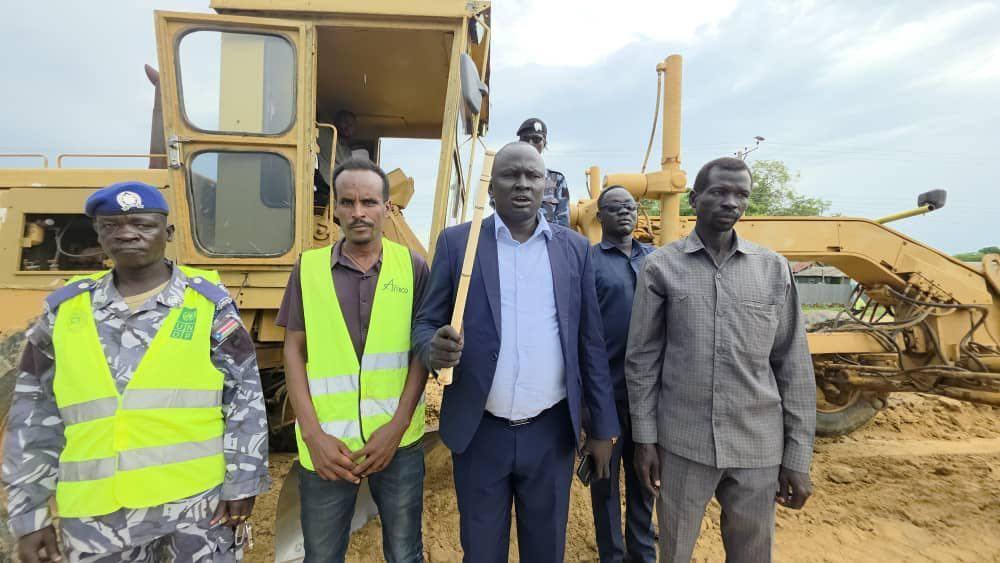
Road construction machinery in South Sudan. Illustrative photograph; not identified as an ABMC project. Photo: Africa-Press.
3. Aggregate Crushers: Building the Foundation of Infrastructure
One of the less discussed aspects of the ABMC story is the importance of aggregate production itself.
Stone crushers and quarry operations are not simply industrial machines. They form part of the foundation of the construction industry. Crushed stone is used in road foundations, concrete production, drainage works, building construction and other infrastructure projects.
By establishing crushing operations around Jebel Kujur, ABMC entered a sector that was essential to Juba's expansion. The business also helped demonstrate the importance of local construction-material production rather than depending entirely on imported materials.
For South Sudan, the long-term development lesson is clear: a sustainable construction industry needs local quarries, reliable equipment, skilled operators, engineers, transport services and transparent procurement.
4. Luri: Agriculture and the Search for Productive Investment
Beyond construction, Luri has also featured in reporting about agricultural activities connected to the ABMC business network.
In its June 2015 investigative profile, Radio Tamazuj reported that ABMC operated an agricultural project on a private farm in Luri associated with President Salva Kiir. The report discussed the company's links to agricultural activity in the area.
The agricultural dimension is important because South Sudan cannot build a strong economy through roads and construction alone. Farming, food processing, storage, milling and local manufacturing are essential to reducing dependence on imported food and creating employment.
There have also been references to a facility described as the "Blessing Miller" in Luri. However, Kolongdit Media has not independently established its ownership, operational status, production capacity or direct connection to Bol Mel. We therefore do not present those details as verified facts.
If properly developed and supported, agricultural milling facilities can help farmers process their harvests locally, reduce post-harvest losses and create value within rural communities.
5. ARC Resources and the Juba–Bor Road
After ABMC, the business story continued through ARC Resources, a company associated in reporting and investigations with Bol Mel.
One of the most significant infrastructure projects linked to ARC was the Juba–Bor highway. The road is strategically important because it connects the national capital with Bor, the capital of Jonglei State, and serves communities, traders, farmers and travellers along the corridor.
In June 2021, Sudan Tribune reported that the Minister of Roads and Bridges had told President Salva Kiir that construction of the Juba–Bor road was nearing completion. The report identified Africa Resource Cooperation Company as the contractor.
The Ministry of Roads and Bridges currently describes the Juba–Bor route as a 192-kilometre connection between Juba and Bor and identifies its importance for commerce and regional connectivity.
For residents and businesses, a reliable Juba–Bor road can mean easier movement of agricultural products, lower transport difficulties, improved access to services and stronger economic links between Central Equatoria and Jonglei.
The road's importance should not be measured only by its construction contract. Its lasting value depends on the quality of the road, maintenance, drainage, safety and the ability of ordinary citizens to use it throughout the year.
6. The Oil-for-Roads Programme and National Infrastructure Ambitions
Bol Mel became closely associated with the government's Oil-for-Roads programme, under which oil revenues were used to finance major road-construction contracts.
The programme was presented as an ambitious effort to address South Sudan's enormous infrastructure deficit. A country with vast distances, weak transport links and limited paved roads needs a functioning national road network to connect its states, counties, markets and border crossings.
Companies associated with Bol Mel, including ARC Resources and other contractors, received major infrastructure contracts under this programme. The ambition was significant: to connect communities and open up the country through improved roads.
However, the programme has also faced serious criticism. A 2025 report by the United Nations Commission on Human Rights in South Sudan examined the contracts, their costs, the procurement process and the amount of road actually completed. The Commission reported that less than five per cent of the inter-city road length contracted to companies associated with Bol Mel had been completed to regional industry standards by early 2025.
The findings are serious and deserve public scrutiny. The government disputed the Commission's allegations and findings. The figures and allegations should therefore be understood as the Commission's reported findings, not as a criminal conviction of Bol Mel.
For the country's development, the central issue is whether public money produces durable roads that citizens can see, use and benefit from. South Sudan needs both ambitious infrastructure investment and transparent accountability.
7. Wau and the Bahr el Ghazal Road Network
Bol Mel-associated companies were also linked in reporting to infrastructure plans in Western Bahr el Ghazal.
In October 2023, Africa-Press reported that a 60-kilometre urban road project in Wau had been launched, with ARC identified as the implementing company. The project was intended to improve movement within the state capital and support local commerce.
But a launch is not the same as completion. Radio Tamazuj subsequently reported in November 2024 that work on the Wau urban road project had stalled amid funding difficulties.
The wider Juba–Bahr el Ghazal highway is another important example. The road is expected to connect Juba with communities and towns in the Bahr el Ghazal region, improving access to markets, public services and national trade routes.
In January 2026, Eye Radio reported that the highway project had been returned to its original Chinese contractor, Shandong High-Speed Construction Company, after it had previously been taken over by ARC. The government relaunched work on the Terekeka–Awerial section.
This history illustrates both the scale of the national road ambition and the difficulties that have affected implementation. The people of Bahr el Ghazal deserve a completed, durable highway, not repeated delays and announcements.
8. Fuel Storage, Logistics and Other Industrial Claims
Supporters have also associated Bol Mel's wider business activities with fuel storage, logistics and industrial investment, including references to a fuel depot.
Fuel storage infrastructure can be important for a country that depends heavily on road transport and imported petroleum products. Properly regulated depots can strengthen supply security, support construction machinery and reduce interruptions to transport and business operations.
However, Kolongdit Media has not independently verified the ownership, capacity, operational status or direct connection to Bol Mel of the particular fuel depot mentioned in public discussions. We therefore do not attribute it to him as an established achievement without further documentary evidence.
9. Beyond Roads: What South Sudan Needs from Its Business Leaders
The larger development question raised by Bol Mel's business career goes beyond one individual or one company.
South Sudan needs more local entrepreneurs who can invest in productive sectors, establish industries, train young people, create jobs and develop local supply chains. It needs construction companies that can build roads to international standards, agricultural businesses that can process local produce, and fuel and logistics infrastructure that supports national economic activity.
It also needs public institutions strong enough to ensure that government contracts are competitively awarded, properly supervised and completed. Public investment must deliver measurable benefits to citizens, especially in a country where communities face poor roads, limited healthcare, unemployment and food insecurity.
10. The Legacy: Ambition, Projects and Accountability
Dr. Benjamin Bol Mel's business career has left a visible place in South Sudan's infrastructure and political history. His association with ABMC brought mechanised aggregate production into the Juba construction market. His companies became involved in urban roadworks and major highway contracts, including the Juba–Bor corridor. His business network also featured in the national debate over the Oil-for-Roads programme.
For his supporters, these activities represent ambition, entrepreneurship and an attempt to address the country's development challenges. They point to the importance of local companies and the need for South Sudanese investment in national infrastructure.
For critics, the record raises serious questions about the value of contracts, transparency, public spending and the delivery of promised roads. Those questions cannot be dismissed; they require credible answers, independent audits and lawful procedures.
Ultimately, the strongest legacy any public figure or business leader can leave is infrastructure that continues to serve the people: roads that remain usable, bridges that are safe, industries that create employment, farms that produce food and public resources that are accounted for.
South Sudan needs development that can be measured not only in contract values or political announcements, but in kilometres of quality roads completed, jobs created, goods transported, farmers supported and communities connected.
That is the standard by which every development legacy should be judged.
KOLONGDIT MEDIA
TRUTH FIRST. CONSEQUENCES ALWAYS.
Editorial note: This feature distinguishes documented company activities and reported infrastructure contracts from claims that have not been independently verified. It does not imply that every project was completed or that allegations constitute proven criminal conduct. Kolongdit Media welcomes documented responses, project records and clarifications from Dr. Benjamin Bol Mel, his representatives, the companies concerned and relevant government institutions.
Sources and further reading:
1. Radio Tamazuj, "Profile: ABMC President Benjamin Bol Mel", June 23, 2015.
2. Eye Radio, "Juba roads graded", April 10, 2014.
3. Radio Tamazuj, "Roads built by ABMC never handed over to Central Equatoria govt", June 26, 2015.
4. Sudan Tribune, "Juba-Bor road construction nears completion: minister", June 16, 2021.
5. Ministry of Roads and Bridges, Republic of South Sudan, Juba–Bor Road project information.
6. Africa-Press, "60km tarmac road construction launched in Wau", October 23, 2023.
7. United Nations Commission on Human Rights in South Sudan, report A/HRC/60/CRP.5, 2025.
8. Eye Radio, "Adut relaunches Bahr el Ghazal road, confirms return of project to Chinese firm", January 25, 2026.
Comments
Post a Comment